 Larisa Maly
When every minute counts -
An agent proposes.
The admin decides.
How I redesigned network operations from monitoring to decision-making - the assignment loop: from ~8 minutes with tables to ~4 today, and the agent aims to halve it again.
Try the live demo (opens in a new tab)About SyncOps
Real-time SaaS for fiber-network operations at a large telecom - shipped and in daily use. The agentic layer shown here is designed ahead of its build.
My Role
- Research
- User Interviews
- Personas and Journeys
- UX Strategy
- AI Agentic Design
- Wireframes & Prototypes
- Usability testing
Outcome - the assignment loop dropped from ~8 to ~4 minutes, estimated with ops.
Scope
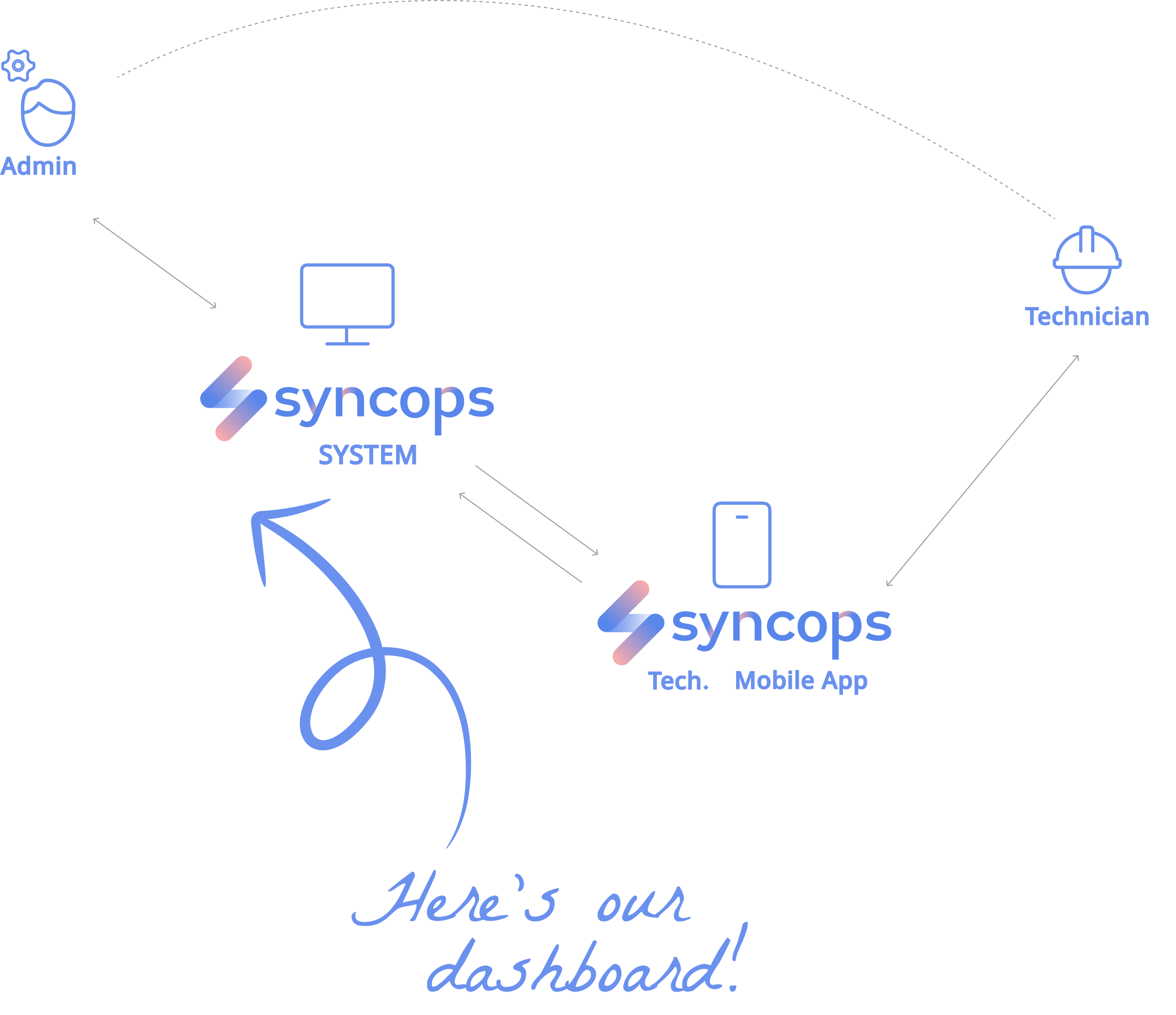
My scope: the admin dashboard - research to UI. It syncs in real time with the technicians’ mobile app - a separate product.
Under NDA - every name, screen and data point here was recreated from scratch. Nothing is client material.
The Issue Wasn’t Visibility.
It Was Time-to-Decision.
Every assignment still fused location, skills, workload, traffic and weather - in the admin’s head, under SLA pressure.
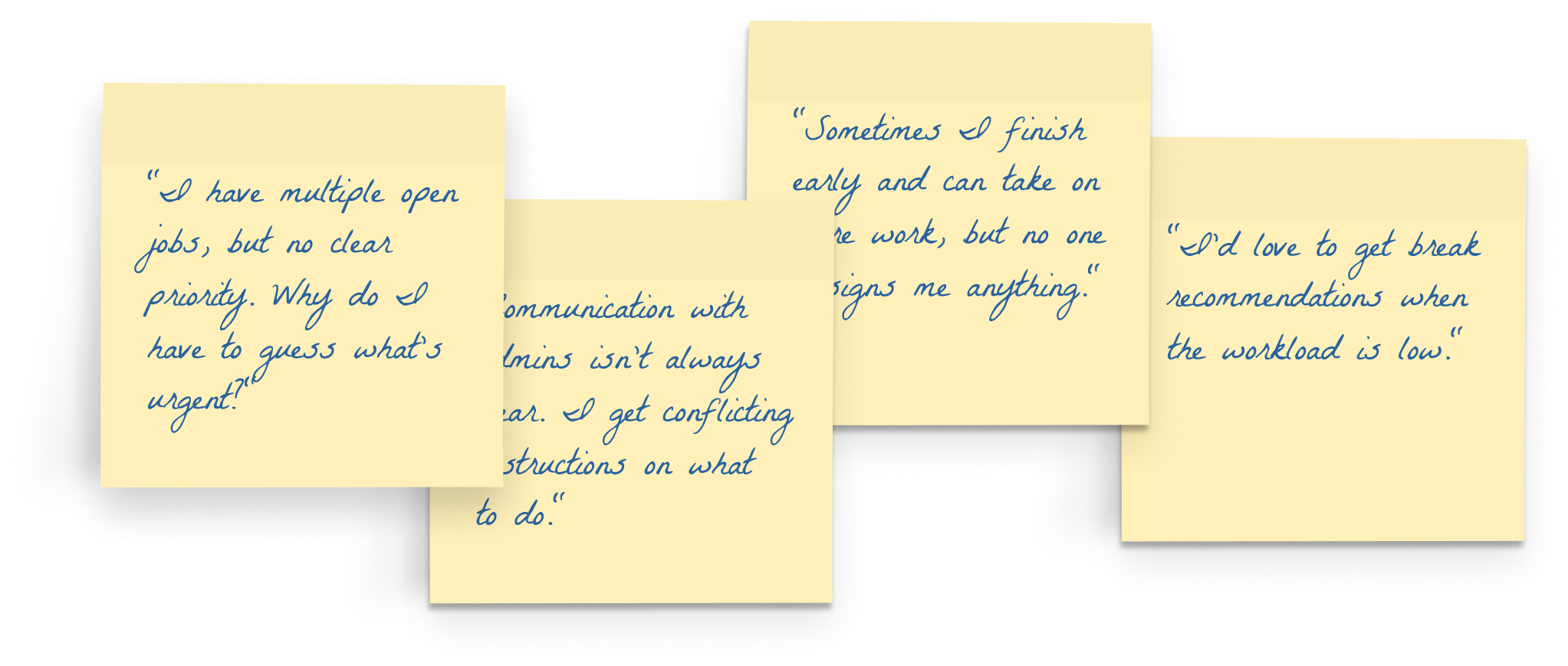

I’m wasting too much time finding an available technician! Why isn’t there a tool that does this for me?
- Administrator, user interviews
Issues remain open for hours because no one notices they haven’t been assigned.
- Administrator, user interviews
Grounded in the
Original Study.
Prefer Map-Based, Real-Time Operations
Admins Asked For A Faster Way To Respond
The Assignment Loop In The Old Table System
Point To Admin - Tech Communication Gaps
Ask For Predictive Maintenance Alerts
The original SyncOps study - interviews with 8 admins and 4 field technicians, field observations, and conversations with their managers. It also benchmarked Praxedo, ServiceNow and Nagios, plus a literature review.
Tamar Prinsy Administrator
Coordinates a central-region team in real time.
“I’m wasting too much time finding an available technician.”
Avi Oren Field Technician
Ten years in fiber optics. Slowed by unclear briefs; stuck in traffic between sites.
“I have multiple open jobs, but no clear priority.”
Users Asked For An Agent -
Before The Word Existed.
Why isn’t there a tool that does this for me?
- Administrator
No one notices they haven’t been assigned.
- Administrator
I’d rather do preventive work than take a big fault - it’s also less load on my people.
- Area managerThree Ways
to Add Intelligence.

Full Automation
Agent assigns silently.
Rejected - trust dies on the first hidden mistake.

Smarter Alerts
More alerts, better sorted.
Rejected - the alert informs, but the decision stays manual.

Graduated Autonomy
The agent acts where safe, proposes where high-stakes, and always explains its reasoning.
Chosen
Solves the actual problem - Time-to-Decision - without giving up human control. Reduces load on the operator while building system trust over time.
Six Signals,
One Decision.
The agent continuously fuses operational data into one actionable proposal.
INPUT
- Live GPS & workload
- Skills & shift hours
- SLA clocks & issue history
- Admin rules & zone constraints
- Traffic & ETA Public APIs · external, non-sensitive
- Weather Public APIs · external, non-sensitive


Agent
OUTPUT
- One ranked proposal
- Confidence when unsure
- Plain-language reasoning

The agent fuses internal operational data with public traffic and weather APIs - no new data exposure, no proprietary data leaves the platform.
Where This
Sits in 2026.
Agent proposes, human approves - Salesforce, GA May 2025. Traffic-aware ETAs - Salesforce, Oracle, Microsoft.
Visible confidence with a threshold - the agent says how sure it is. Below the bar it doesn’t propose - it stops and hands the decision back.
One-click comparison - every proposal shows who came second and why the winner won - and you can swap.
Coverage alerts - the agent looks ahead at the shifts and flags an area about to be left short - with a fix attached.
Daily digest - one tidy morning brief: what happened, what the agent did alone, what needs a decision - instead of 60 cards.
Traffic and weather re-planning - a jam or a storm isn’t just a new ETA - it’s a reason for the agent to propose a different assignment.
Vendor release notes and product docs, 2025 - verified Aug 2026.
Salesforce, Oracle and Microsoft ship pieces of this list. The whole of it - nowhere yet.
How the Agent
Reaches a Proposal
Collect
All six signals, continuously
Filter
Hard constraints: skill, area, shift hours, safety
Rank
Travel time, workload balance, SLA risk
Score
Confidence based on data freshness and margin
Decide
Above the threshold it proposes. Below it, the agent holds and asks.
From Five Manual Steps
to One Decision.
Before - The manual loop
- Spot the issue
- Scan the technician table
- Check availability
- Weigh skills & distance
- Assign & notify

After - With the dispatch agent
- Review the proposal and its reasoning
- Approve. One click.
What the Agent Does
Automatically →
The Map Is
The Agent’s Canvas.
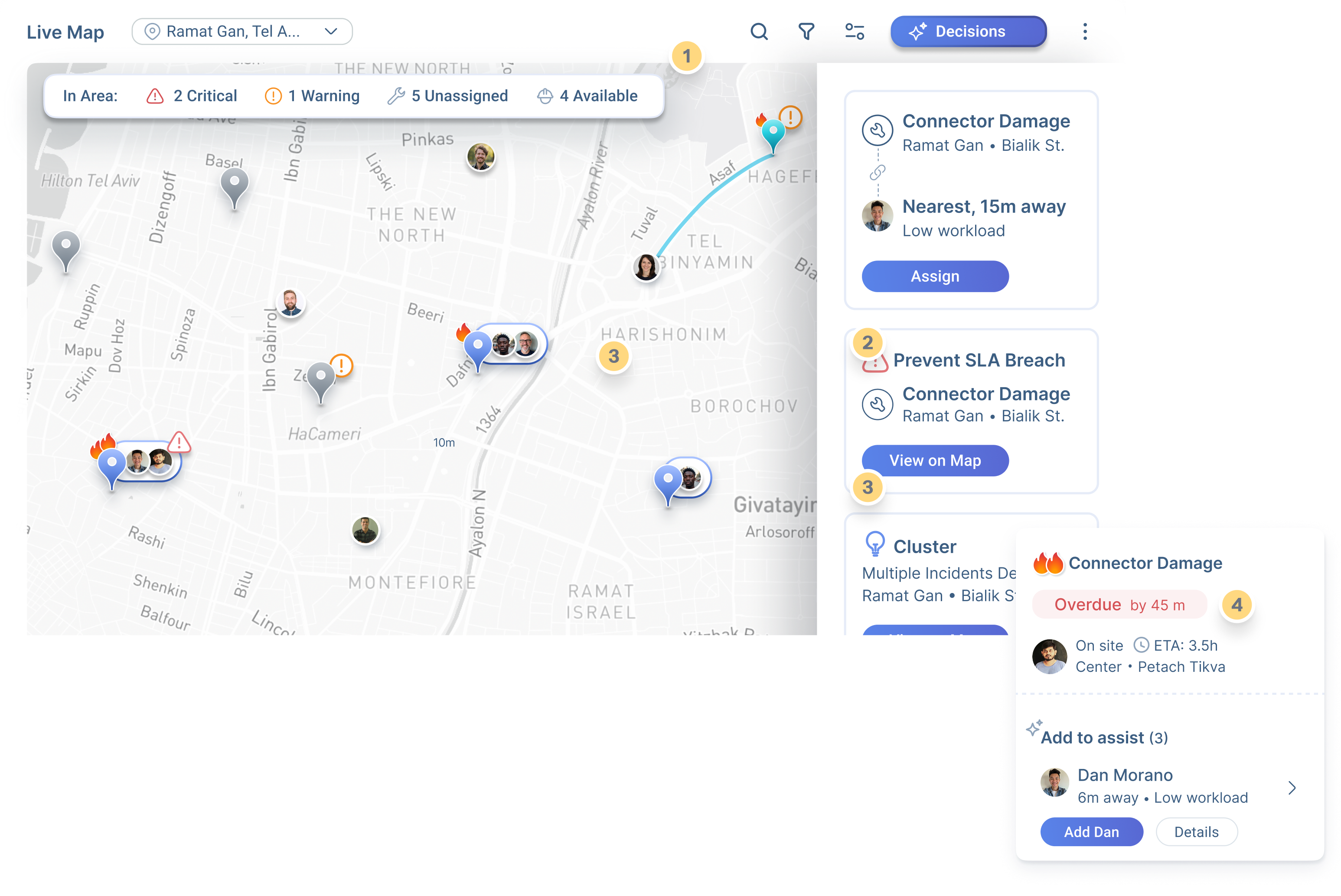
Why the map leads: spatial decisions are the fastest to make visually - the queue and roster answer what the map can’t.
What the admin used to hold in her head, the agent now shows on the map - proposals, risks, and clusters, in place.
Assignment Proposal
“11m away, skills on hand” - the agent’s pick, one click to approve.
SLA Watchdog
“Expires in 45m” - flagged before the clock runs out, not after.
Cluster Detection
“2 open incidents, 1.7 km apart” - the agent spots a pattern a human would miss.
Coverage Alert
“Ramat Gan drops to 1 tech at 16:00” - a gap surfaced before it becomes a problem.
Preventive Check
“3 connector faults in 30 days” - the inspection is booked before the fourth.
Anatomy of
a Decision.
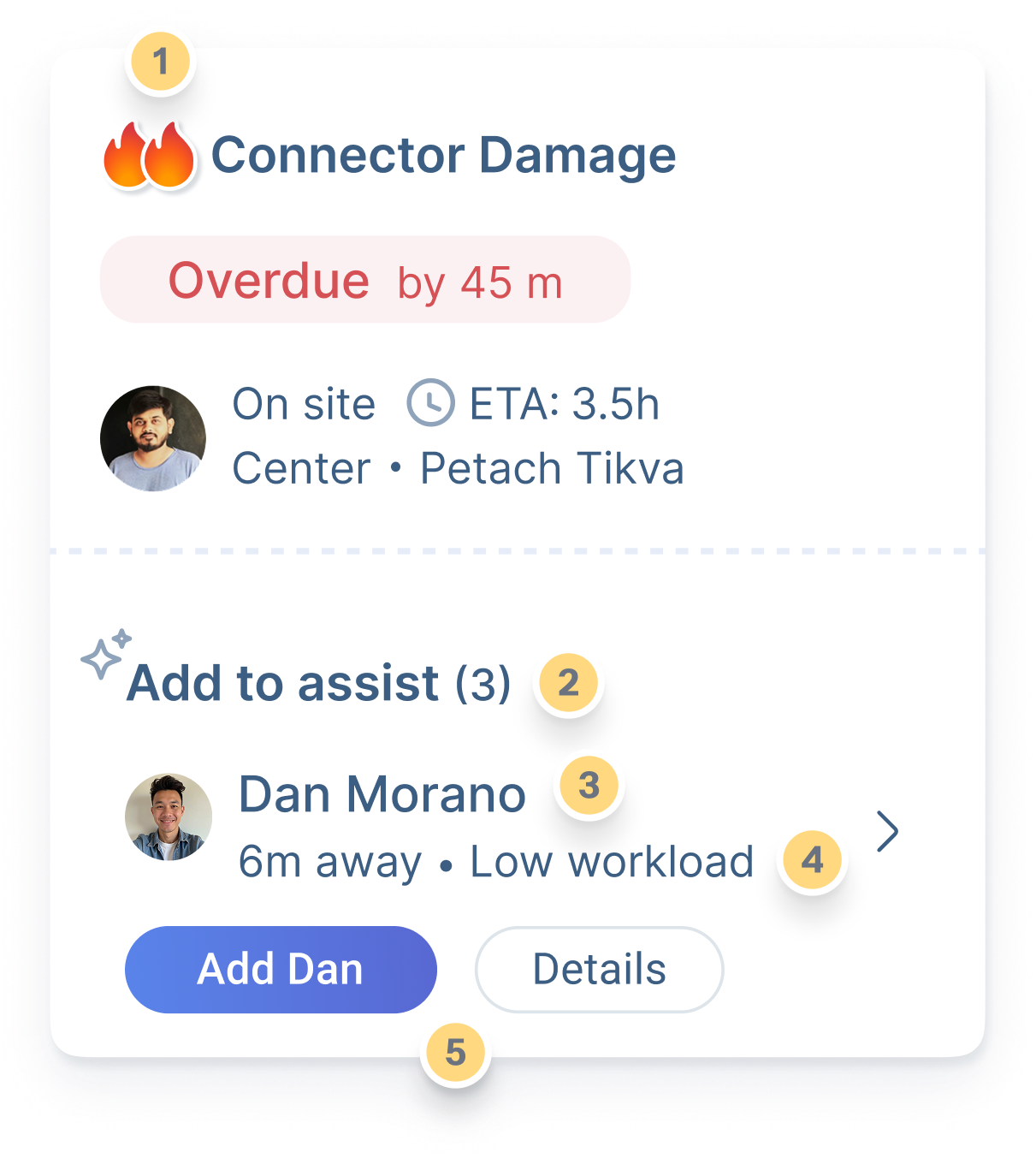
Urgency
Severity + SLA clock set the row’s priority and colour
Context
Nearest technician, workload, distance - fused automatically
Certainty
No score on confident calls - a number appears only when the agent is unsure
Reasoning
One Why on the person - skills, ranking, and the runner-up
Next Action
One primary button: Assign. Everything else is secondary
Autonomy,
By Design.
Risk and reversibility set the level. Nothing acts silently.
Acts Alone
- Queue triage & prioritization
- Status sync & closure
- Event digests
Low-risk, reversible, always logged.
Suggests
- Technician assignment
- SLA-risk reassignment
- Preventive tasks
One-click approve, reasoning attached.
Never
- Silent dispatching
- Acting below the confidence threshold
The agent steps back and asks.
When the Agent
Isn’t Sure.
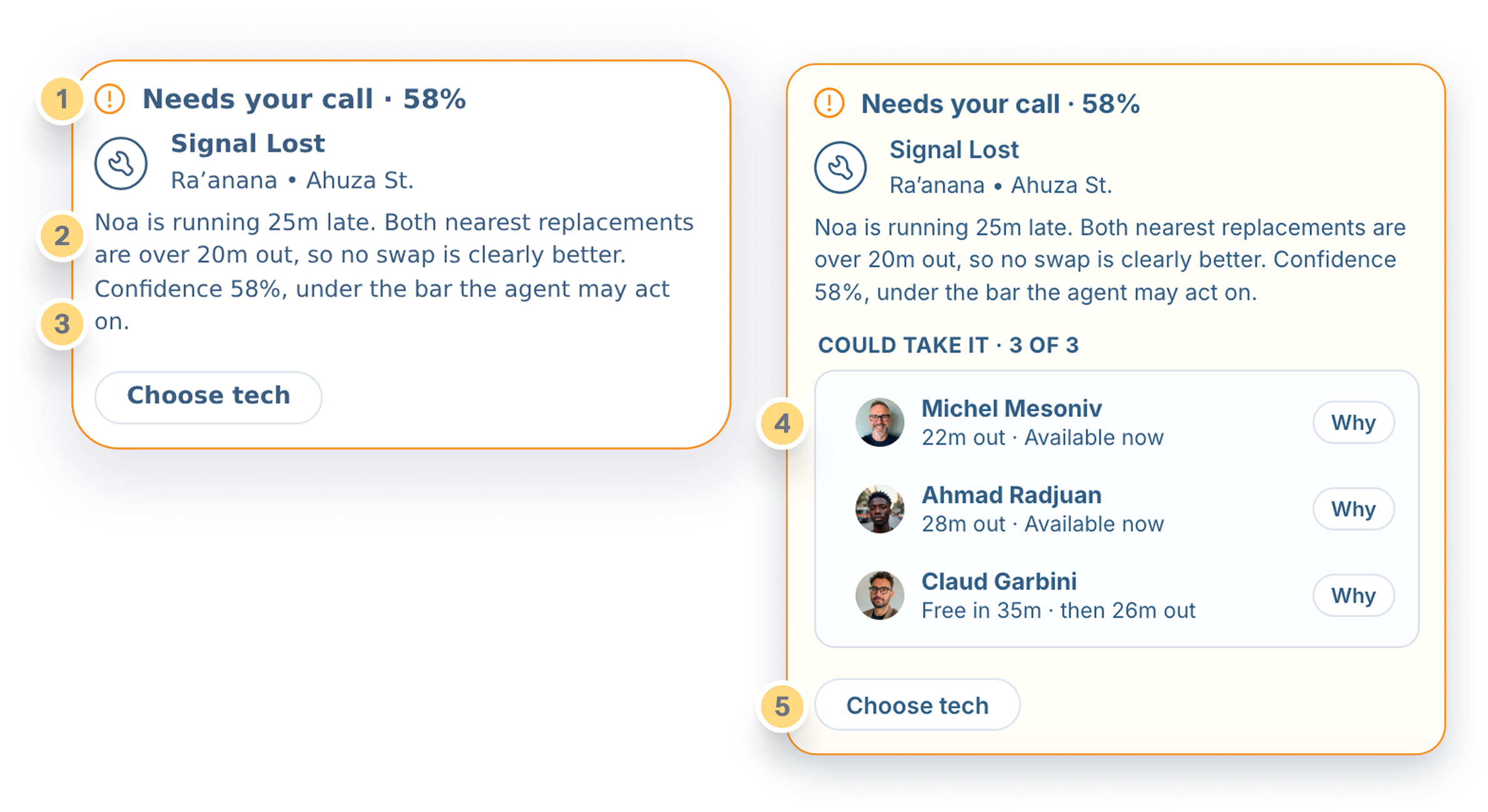
Held, Not Pushed
Below the threshold the agent proposes nothing - it flags and waits
Why It’s Unsure
Two reasons, in plain language - never a black box
58% - Under The Bar
High-stakes dispatch stays above the threshold. This one doesn’t. The bar is tuned with ops - every override calibrates it
Paths, Not A Pick
Tamar compares options or asks the agent to dig deeper
Admin’s Call
The decision stays human. The agent records the outcome
Human-in-the-Loop,
By Design.

Certainty
Reasoning always, a score when unsure

Explainability
“Why this technician” - one tap

Control
Approve · edit · override, one click

Undo
Agent actions are reversible

Transparency
Activity log of every agent step
Activity
- 12:41 · Tamar approved the proposal
- 12:41 · Briefed task sent to the field app
- 12:38 · Proposal created - Michel, 11m out
Every entry names the job it touched - an audit trail the admin can stand behind.
A day with the agent -
Tamar Prinsy
A digest, not noise
One prioritized morning summary replaces a wall of alerts.
The watchdog catches a delay
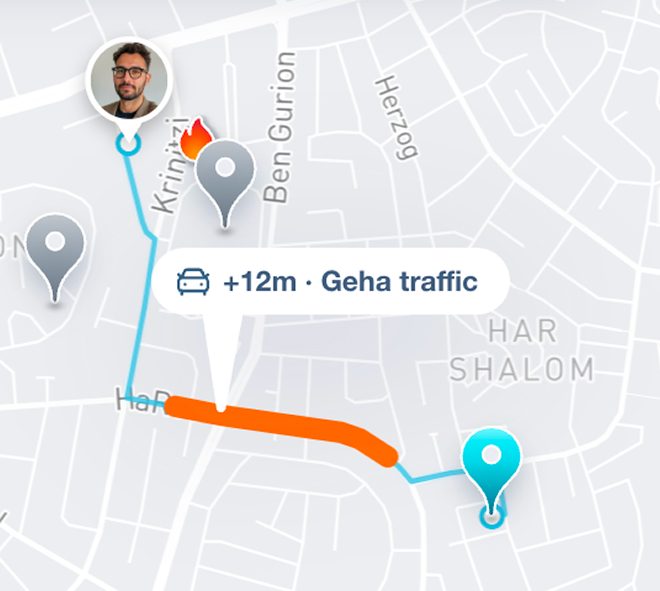
Traffic holds a technician; the agent proposes a reassignment before the SLA breaks - a scenario straight from the original journey map.
One click. Her call.
Tamar approves. The system executes. Credit stays with the admin.
The agent isn’t sure
Signal Lost at 58% - the agent flags it and waits. Tamar decides.
And on Avi’s side
Avi once asked for break recommendations on slow days. The agent surfaces that - as a proposal on Tamar’s board. The approved task lands in his field app, briefed and complete.
From Reactive
to Preventive.
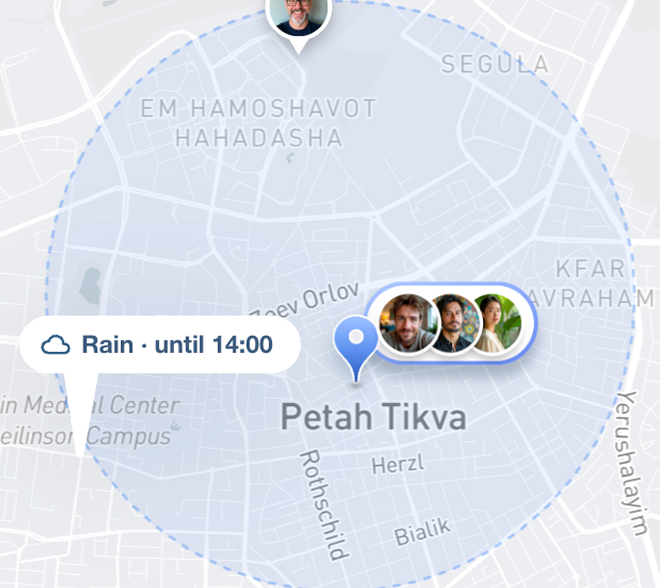
 Flag
FlagRisk areas surface on the map - issue clusters, traffic and incoming weather.
 Propose
The agent drafts preventive tasks for at-risk segments - never silently scheduled.
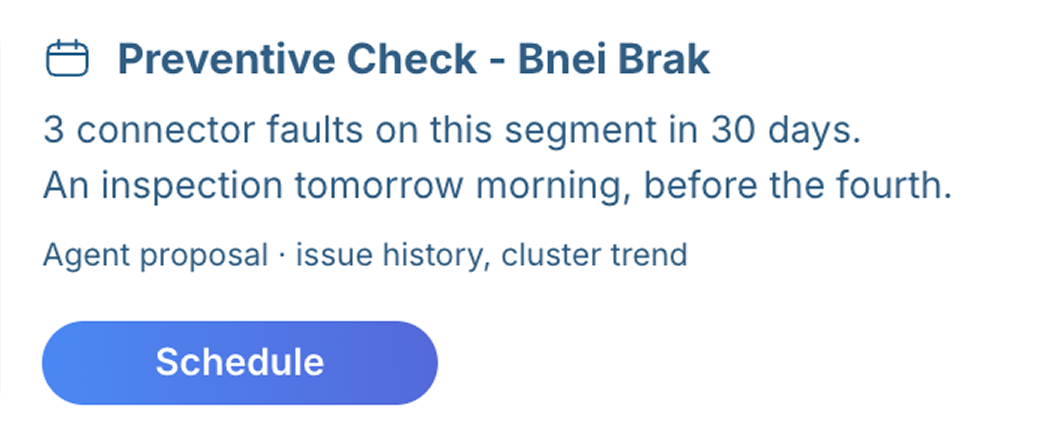
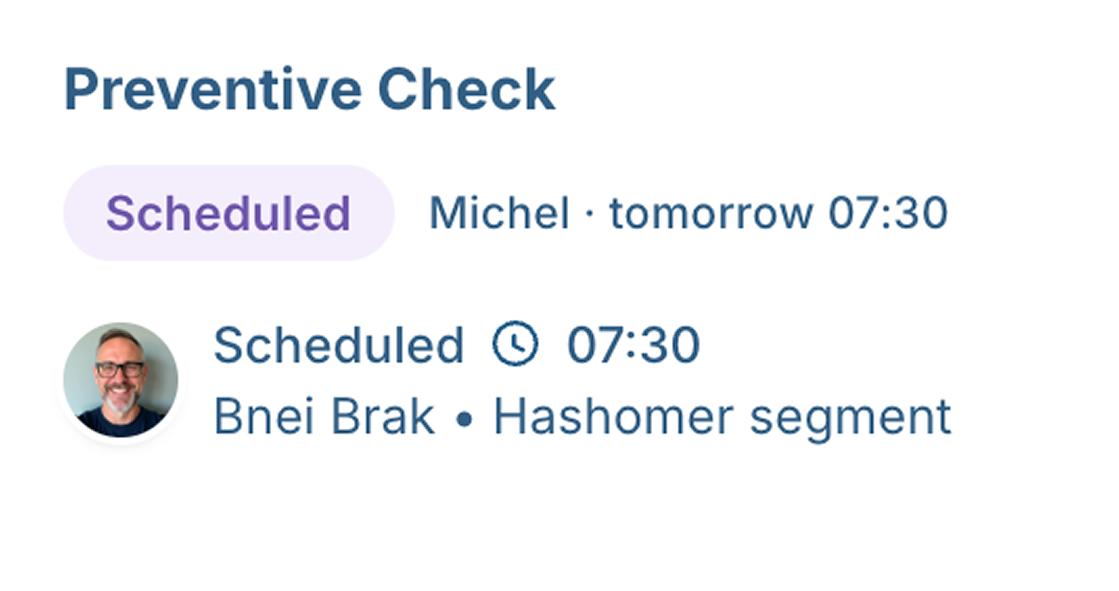
 Approve
Admins turn proposals into work orders. Prevention becomes routine, not luck.
of the 12 people interviewed asked for predictive alerts - in the original study.
Forward
Estimates.

Time to assignment
The admin’s part - alert to dispatch. Expected to drop by about half, from ~4 minutes in today’s dashboard.

SLA breaches prevented
Near-breaches caught in time. Expected to climb - field-service cases move on-time from 76% to 91%.

Decisions per hour
Throughput expected to grow 2-3x - dispatchers will run 40+ techs instead of 10-15.

Utilization balance
The gap between loaded and idle expected to shrink - 6-8 jobs per tech instead of 3-5.

Override rate ↓
Overrides expected to fall toward 5-10% - the bar for mature systems.
The agentic layer is design work ahead of its build - it ships with its measuring stick already defined. The ~50% target rests on today’s ~4-minute baseline - after the move from tables already cut it from ~8 (estimated with ops); the rest lean on benchmarks from adjacent field-service domains, not telecom. Halving today’s loop returns about an hour a day at the conservative end. All of it is estimate, not claim.
Sources: Upper - Auto Dispatch for Field Service · Baytech - Agentic AI Dispatch, 2025.
What Designing An
Agent Taught Me
- Making the agent right was half the work. Making Tamar trust it was the rest.
- If I started again, I’d design the failure states first.
- The hardest calls were about information - what to show, and what to keep one tap away.
- Suggest first - autonomy expands as trust grows.
- The most valuable thing my agent says is: I’m not sure.